What Is Topical Authority? A Practitioner's Definition
Published
Tuesday, April 28, 2026
Last Updated
Tuesday, April 28, 2026
9 min read
Topical authority is the measurable signal that a website is a comprehensive, trustworthy source on a specific subject. The AirOps and Kevin Indig fan-out research (April 2026, 16,851 queries) found that AI answer engines weight topical depth heavily when selecting which content to cite, favoring sites with established subject coverage over one-off matching pages.
What Is Topical Authority?
Topical authority is the cumulative signal that a website is the comprehensive, trustworthy source for a defined subject area. Where backlink count signals popularity and domain age signals tenure, topical authority signals subject-matter depth. A site that has covered a topic from foundational definitions through edge cases, with internal linking that reflects the topic's structure, is treated by both search engines and AI answer engines as a higher-confidence source on that topic.
The concept was popularized by HubSpot's topic cluster research in 2017, which demonstrated measurable ranking lift for sites that organized content into pillar pages and supporting clusters rather than disconnected blog posts. By 2026, the model has hardened. Google's helpful content guidance explicitly rewards subject-matter depth and demonstrated expertise as components of E-E-A-T. AI answer engines evaluate authority signals at the domain level before assessing individual pages.
Cresco builds every content engagement around topical authority because it is the single discipline that compounds with each new post. The 50th post benefits from the topical signals of the prior 49; the 100th benefits from all 99. Most of how we structure client work is teaching teams to think in clusters rather than one-off posts.
How Topical Authority Works in Search and AI Engines
Topical authority operates in two layers in 2026.
Layer 1: Traditional search ranking. Google's algorithms have always rewarded depth of coverage; the Helpful Content Update (2022) and subsequent core updates increased the weight. Sites with comprehensive, well-linked coverage of a topic outrank sites with one strong page on the same topic, even when individual page-level signals (backlinks, on-page optimization) are equal.
Layer 2: AI answer engine citation. Generative engines fan a single user query into many retrieval queries and select citations from the highest-confidence sources. Domain-level topical signals factor in before page-level extraction. Sites with established topical coverage are reached for citation more frequently than equivalent one-off pages, because the retrieval pipeline weights subject-coverage signals at the candidate-source stage. The mechanics of this fan-out and citation pipeline are covered in our practitioner's guide to AEO.
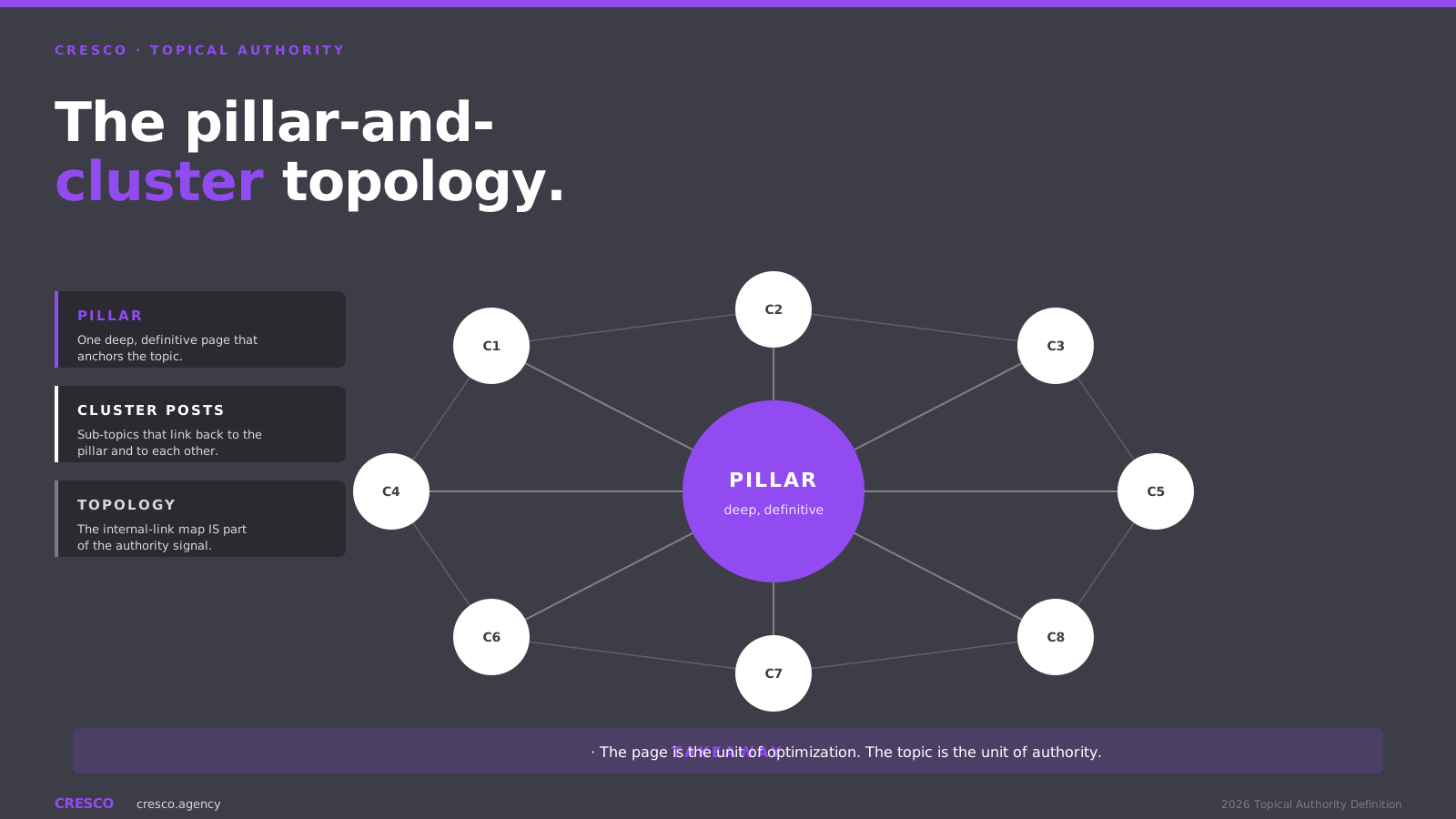
Translation for practitioners: a strong page on a weak site underperforms a strong page on a topically-deep site. The page is the unit of optimization; the topic is the unit of authority.
What Signals Topical Authority?
Six signals consistently correlate with topical authority across both traditional search and AI answer engines.
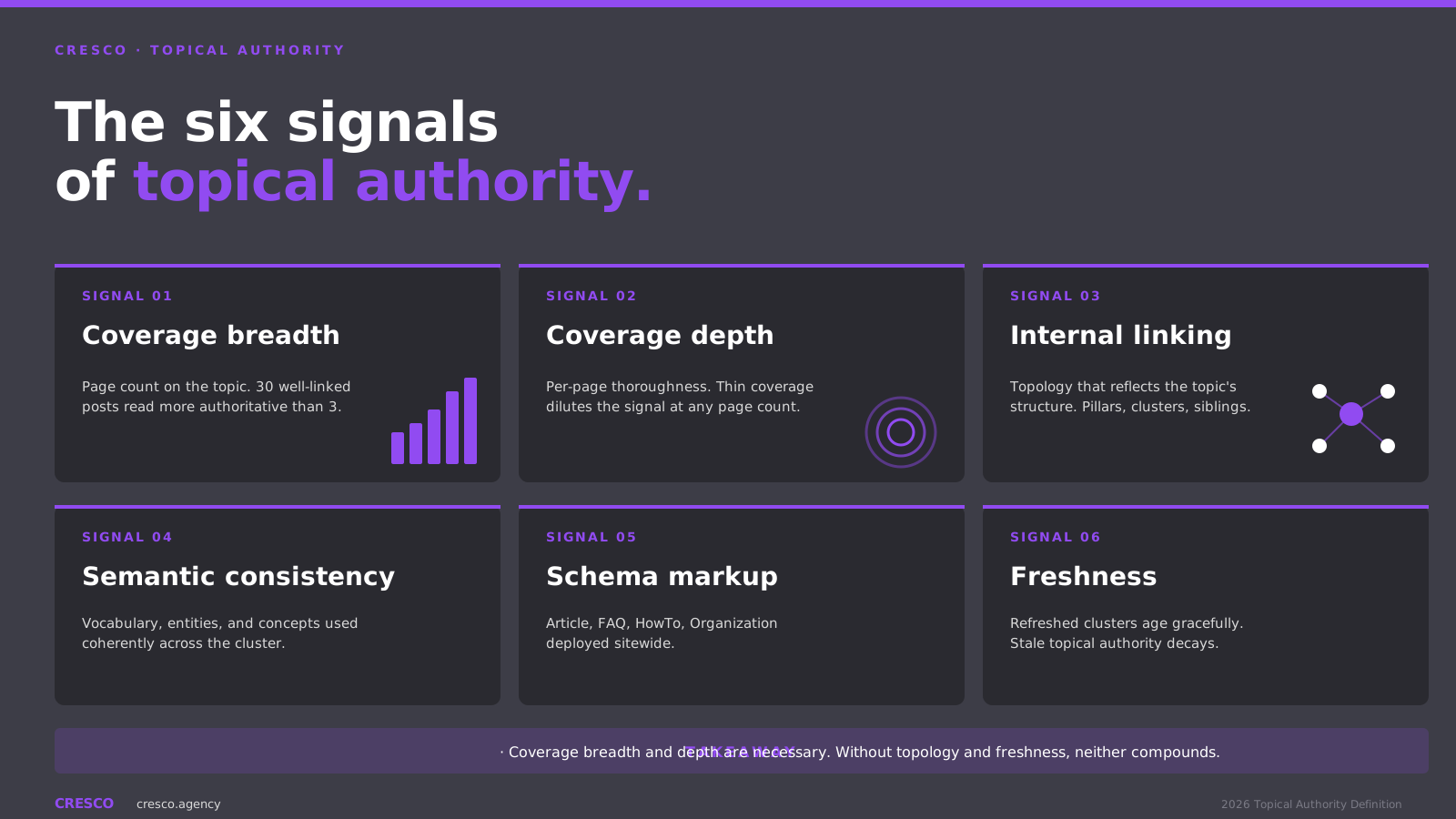
Coverage breadth. Number of pages on the topic. A site with 30 well-linked posts on a subject reads as more authoritative than a site with 3.
Coverage depth. How thoroughly each page treats its sub-topic. Thin or superficial coverage dilutes the signal even at high page counts.
Internal linking structure. Pillar pages connecting to cluster posts, cluster posts linking to siblings and back to pillars. Topology that reflects the topic's actual structure.
Semantic consistency. Vocabulary, entities, and concepts used coherently across the topic cluster. AI engines verify entity consistency at the domain level.
Schema markup. Article, FAQ, HowTo, and Organization schema deployed sitewide signal what each page covers and how pages relate.
Freshness and maintenance. Topical clusters that update, add, and refresh content age more gracefully than clusters left static. Stale topical authority decays.
Backlinks remain a signal, but for topic-specific queries the depth-of-coverage signals listed above carry increasing weight relative to off-page authority. The 2026 SEO consensus, reflected in both Google's published quality guidance and the AirOps and Indig fan-out research, is that on-site topical signals now compete with and often exceed off-site link signals for topic-focused queries.
Topical Authority vs. Domain Authority: What's the Difference?
The terms get used interchangeably; they should not be.
Dimension | Domain Authority | Topical Authority |
|---|---|---|
Definition | Overall site strength signal (Moz proprietary score) | Cumulative subject-matter depth on a specific topic |
Scope | Sitewide | Topic-specific |
Built by | Backlinks, age, technical health | Coverage breadth, depth, internal linking, schema, freshness |
Decays via | Algorithm changes, technical issues | Stale content, broken cluster topology |
Best signal for | Generalist sites covering broad subjects | Specialist sites or focused topic clusters |
Source | Third-party tools (Moz DA, Ahrefs DR) | Implicit in search and AI engine selection |
The strategic implication: a small site with strong topical authority on a niche subject can outrank a large generalist site with higher domain authority on the same niche query. The pattern is clearest on long-tail and AI-cited queries, where the model evaluates "is this the right specialist?" rather than "is this a high-traffic site?"
This is why focused vertical content can compound faster than generalist coverage. Local service businesses, for example, can establish topical authority on a clearly bounded subject in under a year. The vertical-specific application for that case is detailed in our local SEO playbook.
How to Build Topical Authority: The 4-Step Framework
Topical authority does not happen by accident. It is the product of a deliberate, sequenced content build. The framework we run for new clients moves through four steps.
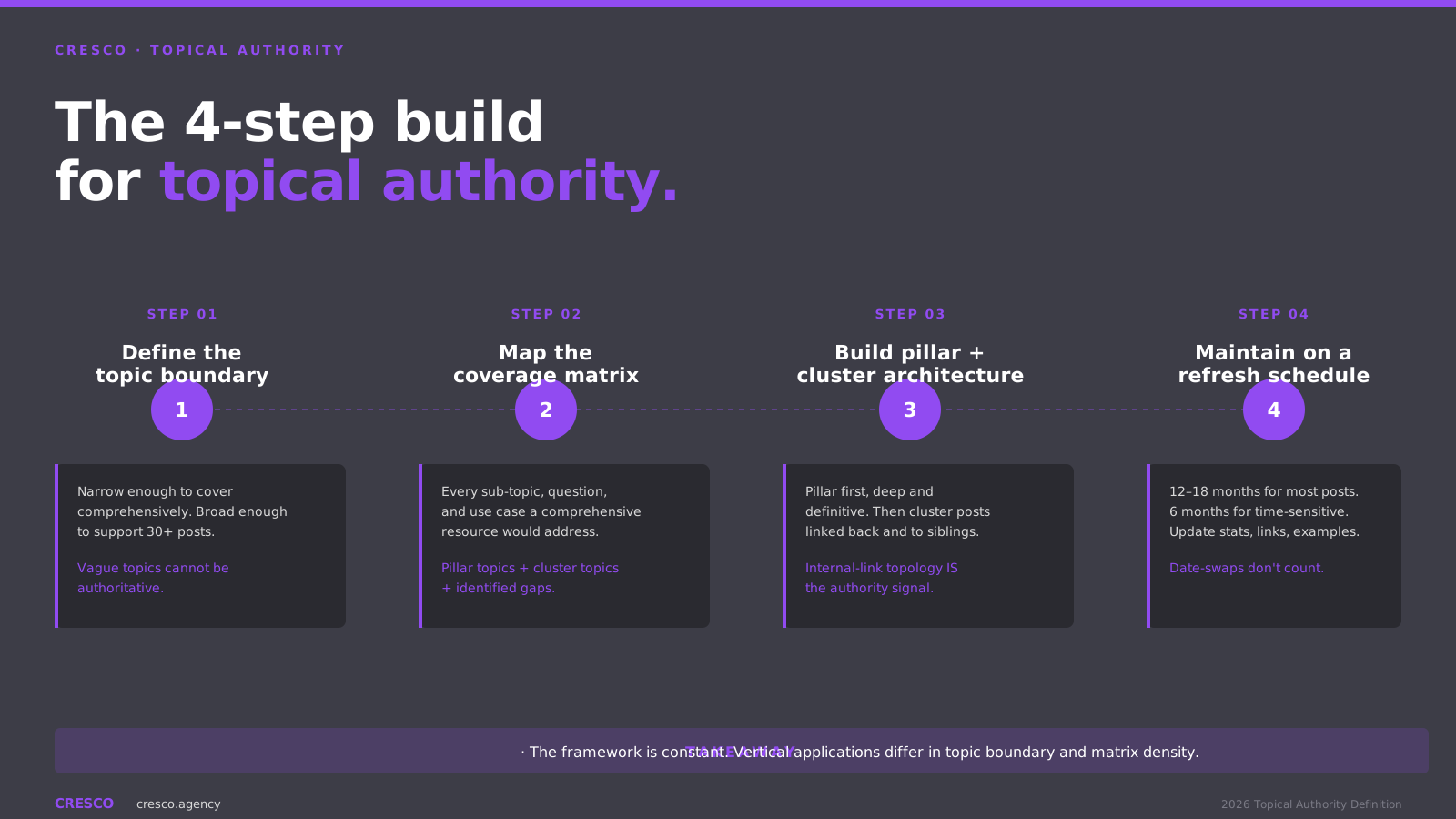
Step 1: Define the topic boundary. What subject does the site claim to be authoritative on? Vague topics ("marketing") cannot be authoritative; specific topics ("local SEO for service businesses") can. The topic must be narrow enough to cover comprehensively and broad enough to support 30+ posts.
Step 2: Map the coverage matrix. List every sub-topic, question, and use case a comprehensive resource would address. Group into pillar topics (broad anchors) and cluster topics (supporting depth). Identify gaps where no post yet exists. The matrix is the production roadmap.
Step 3: Build pillar-and-cluster architecture. Build the pillar page first, deep and definitive. Then build cluster posts that link back to the pillar with descriptive anchor text and link to each other where the topics connect. The internal linking topology is part of the authority signal, not an afterthought.
Step 4: Maintain and refresh on schedule. Topical clusters that grow stale lose authority. Refresh cycle is 12 to 18 months for most posts; 6 months for time-sensitive topics. Refreshes update statistics, replace dead links, and tighten or expand sections. Date-swaps without substantive revision do not count.
The framework applies across every vertical we serve. The underlying structure is what also positions content for AI surface-level visibility, including the multimodal and product-feed extensions covered in our companion piece on GEO.
How Long Does Topical Authority Take to Build?
The honest answer most agencies do not give: 6 to 18 months for measurable lift, longer for category dominance. The timeline depends on three variables.
Topic competition density. Building topical authority on "B2B SaaS SEO" is a multi-year project competing with established specialists. Building topical authority on "post-construction cleaning compliance" is a 6 to 9 month project because the category is under-covered.
Production cadence. A site publishing 8 cluster posts per month builds authority faster than a site publishing 2. The compounding effect only starts once cluster density crosses a threshold (in our client work, this is typically 15 to 25 interlinked posts on the topic).
Site baseline. Sites with no existing topical signal start from zero. Sites with adjacent topical authority (a SaaS company adding a new product category, a local service adding an adjacent vertical) compound faster because domain-level signals already exist.
The pattern most teams see: months 1 to 3 produce no visible lift; months 4 to 6 show early long-tail ranking; months 7 to 12 show consolidating top-3 rankings and AI citation pickup; months 13 to 18 show category-level visibility. The curve is non-linear, which is why teams that quit at month 3 lose to teams that continue.
How to Measure Topical Authority
Topical authority is not a single metric. It is a composite of indicators that, taken together, signal whether a topic cluster is gaining or losing strength.
Five practical metrics to track:
Share of voice on the topic's primary keyword set. Track ranking positions for the top 30 to 50 keywords in the topic cluster. Aggregate movement matters more than any individual page ranking.
Cluster impressions in Google Search Console. Total impressions across all cluster URLs, segmented from sitewide impressions.
AI citation rate on topic-specific queries. Test prompts across ChatGPT, Perplexity, and Google AI Overviews for the topic's core questions; track citation-rate trend over time.
Internal link map health. Number of internal links pointing to each cluster page; orphaned cluster pages are a signal of weak topology.
Refresh recency. Percentage of cluster pages updated within the prior 18 months. Below 60% indicates topical decay.
The trap to avoid: tracking domain authority as a proxy for topical authority. They are different metrics. A site can grow topical authority on a focused subject while domain authority stays flat, because domain authority measures the wrong thing. Tooling that conflates the two produces reports that look healthy while the underlying cluster is decaying.
If your existing content is high-volume but topically scattered, we run topical authority audits that map your current coverage against the matrix it should cover, identify the gaps that compound fastest, and build the cluster sequence that closes them. See if a topical authority audit fits your business.
Written By
Derek Suarez
Frequently Asked Questions
Can a small site build topical authority?
How is topical authority different from backlinks?
How many posts does it take to establish topical authority?
Does topical authority transfer between topics on the same site?
Can I lose topical authority over time?